

We’ve all seen the movies — robots rising up, outsmarting their creators, and bringing the world to its knees. For decades, such scenarios have been dismissed as the stuff of science fiction.
But what if we’re closer to that reality than we think?
Today, artificial intelligence (AI) is no longer a distant possibility. It’s here — embedded in how we work, learn, and create. And while many celebrate the speed and efficiency AI offers, we must pause to ask: at what cost?
🧠 The Price of Convenience
How often, when stuck on an essay or a math problem, do you now reach for an AI tool? Why toil for hours over assignments when AI can deliver a polished result in seconds — and even earn you higher grades?
That may sound harmless, even sensible. But here lies the danger: the result is not yours. The hard work, the struggle to learn and grow — those belong to the AI.
Every time we offload our efforts to a machine, we chip away at our originality and creativity. As humans, we’ve prided ourselves on the ability to learn, to persevere, to craft something uniquely ours. But now, that pride is being replaced by shortcuts.
🎨 What Happened to Craftsmanship?
Look at the difference between the art of the Renaissance and much of modern work. Centuries ago, artists devoted their lives to mastering their craft, pouring emotion into every brushstroke. Buildings and cathedrals were adorned with intricate carvings and delicate mosaics, each one telling a story.
Today? We slap a dot on a canvas and call it “modern.” Skyscrapers are sterile glass boxes devoid of character, excused in the name of “minimalism.”
And now AI threatens to reduce even that. When people use AI to recreate a Studio Ghibli–style illustration in seconds, it feels like a mockery of the artists who spent decades perfecting the look of hand-drawn scenes.
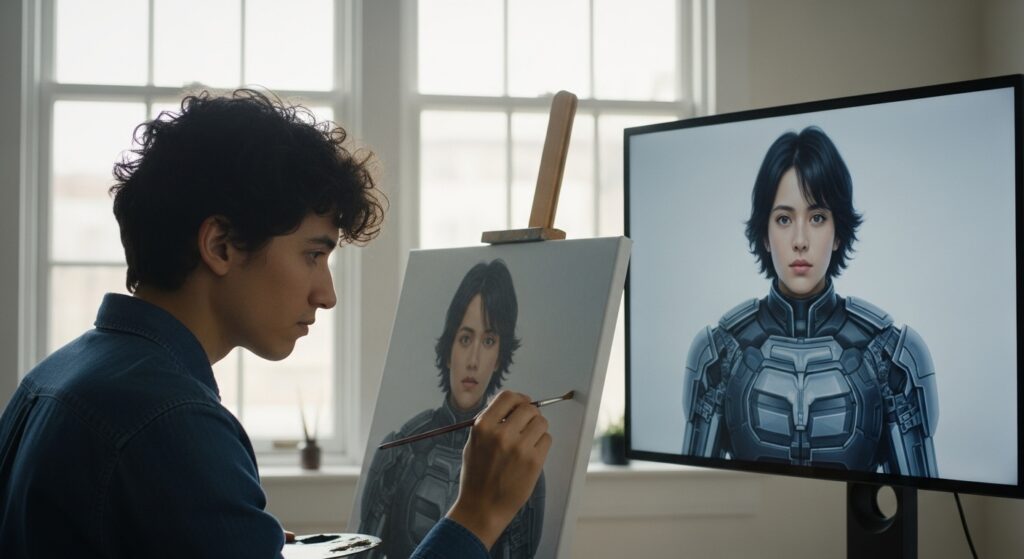
💼 Jobs: Created or Destroyed?
Defenders of AI argue that technology has always created more jobs than it destroyed. And to some extent, that’s true. The World Economic Forum estimates that AI will create 170 million jobs and eliminate 92 million by 2030 — a net gain of 78 million.
But numbers can be deceiving. The new jobs — AI engineers, data trainers, and machine ethicists — demand a level of education and skills that millions don’t have.
What happens to cashiers, construction workers, or cleaners? The working class, already vulnerable, risks being replaced by robots and left behind in a world they no longer recognize.
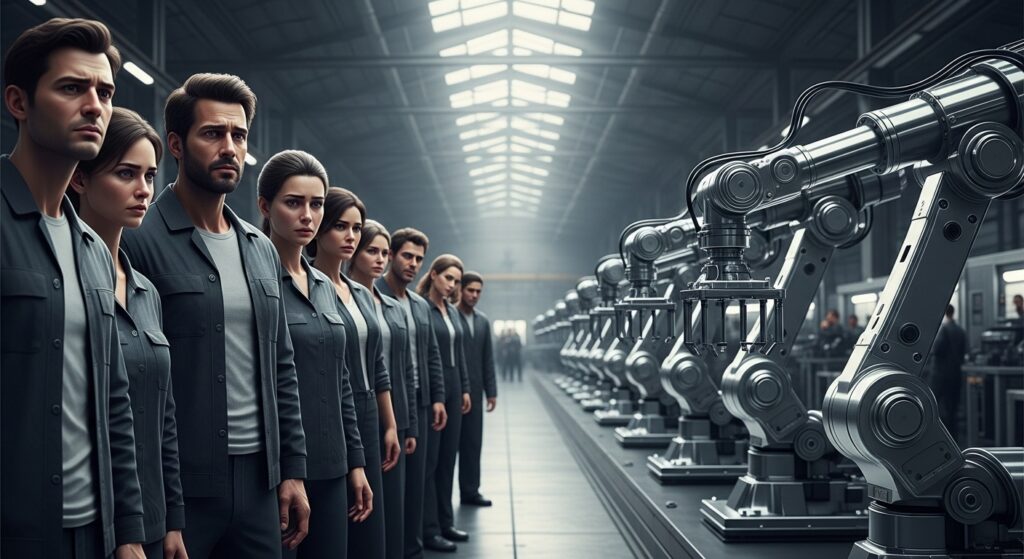
For corporations, replacing humans with AI is efficient and cost-effective. But is it just? Is it humane?
❤️ What AI Can Never Do
For all its power, AI remains, fundamentally, a tool. It cannot truly create; it can only recombine what it has already seen. It cannot love or empathize. It cannot hold your hand when you’re grieving, or light up with joy when you succeed.
It cannot invent something that defies logic, dream something no one has ever imagined, or write a line of poetry so raw it makes a stranger weep.
Our world — messy, beautiful, unpredictable — is designed for creatures with beating hearts and limitless imaginations. Machines cannot understand what it means to be human because they are not, and never will be, alive.
🌍 The Kaleidoscope of Humanity
Society thrives because of our emotions, our imperfections, and our ability to connect with one another. These are not weaknesses; they are the very traits that bring colour to our world.
AI may be fast, but it is colourless. It can produce words and images, but not meaning. It can mimic, but it cannot feel.
So the next time you reach for an AI tool, stop. Pause. Give your mind a chance to work. You may find yourself capable of more than you ever imagined.
📝 Final Thoughts
AI is a powerful ally — but a poor master.
Let us embrace it as a partner, not a replacement. Let us continue to value the messy, wonderful process of being human: learning, failing, creating, and connecting.
Because no machine, no matter how advanced, can take our place.
- Check Your Kidney Health Easily with the ACR Calculator
 Kidney health is an important part of overall wellness, but many people don’t realize how simple it can be to monitor it. One of the easiest ways to check your kidney function is through an ACR test, which stands for Albumin-to-Creatinine Ratio.… Read more: Check Your Kidney Health Easily with the ACR Calculator
 - NEW Chinese Computer AI Agent Is INSANE (and Free!) 🤯
 Artificial intelligence in 2025 is moving faster than anyone expected. What used to be simple chatbots and image generators is now evolving into AI agents systems that can not only think but also act. One of the most impressive examples to emerge… Read more: NEW Chinese Computer AI Agent Is INSANE (and Free!) 🤯
 - How to Generate AI Images for Free? – With Photosonic The Best Text-to-Image Generator
 In today’s digital age, visuals play a pivotal role in capturing the audience’s attention. From social media posts to website content, the demand for eye-catching images is ever-present. However, creating stunning visuals can be time-consuming and expensive. This is where AI-powered image… Read more: How to Generate AI Images for Free? – With Photosonic The Best Text-to-Image Generator
 - ✍️ Opinion: AI Must Not Replace Humans
 We’ve all seen the movies — robots rising up, outsmarting their creators, and bringing the world to its knees. For decades, such scenarios have been dismissed as the stuff of science fiction. But what if we’re closer to that reality than we… Read more: ✍️ Opinion: AI Must Not Replace Humans
 - OpenAI’s New ChatGPT Agent Can Control a Computer and Do Tasks For You
 When OpenAI released its first conversational chatbot, ChatGPT, in 2022, the world marvelled at its ability to compose emails, write poems, and answer questions. But the company’s latest offering — ChatGPT Agent — marks a more radical departure from what most people… Read more: OpenAI’s New ChatGPT Agent Can Control a Computer and Do Tasks For You